

In today’s digital world, creating content isn’t just about ranking higher on Google—it’s about building trust and credibility with your audience. With so much misinformation online, search engines need a way to identify which content deserves to be seen. Google’s E-E-A-T framework—Experience, Expertise, Authoritativeness, and Trustworthiness—plays a crucial role in how search engines evaluate content. While it isn’t a direct ranking factor, it strongly influences whether your website earns visibility at the top of search results or gets lost in the crowd. In this blog, we’ll explain what E-E-A-T is, why it matters for SEO, and how you can leverage it to build credibility and boost your online presence.
What is Google E-E-A-T?
E-E-A-T stands for Experience, Expertise, Authoritativeness, and Trustworthiness.
It’s a framework outlined in Google’s Search Quality Rater Guidelines, designed to assess the quality, credibility, and reliability of content, its creators, and the websites that publish it.
Evolution of E-E-A-T
In 2014 → E-A-T was born
Google first added E-A-T (Expertise, Authoritativeness, Trustworthiness) to its Search Quality Rater Guidelines.
These guidelines are not ranking algorithms themselves, but they tell Google’s human quality raters how to judge the quality of search results.
The idea: content from knowledgeable, credible, and trustworthy sources should rank higher — especially for YMYL (Your Money, Your Life) topics like health, finance, or safety.
In December 2022 → “Experience” was added
Google updated the guidelines and added a new “E” → Experience.
Take product reviews, for example—hearing from someone who’s actually tried the product is usually much more useful than a review based only on researched details.
Example: A product review written by someone who actually used the product is often more helpful than one written by someone who just researched specs.
Why is E-E-A-T Important in SEO?
Connection to Google’s Helpful Content & Core Updates
Helpful Content Update (2022 onwards):
-
-
-
Google shifted its ranking focus toward “people-first” content rather than content made just to please algorithms.
-
Pages must demonstrate genuine usefulness, not just keyword stuffing.
-
E-E-A-T acts as the foundation for identifying such helpful content.
-
-
Core Algorithm Updates:
-
-
-
When Google rolls out a core update, it reassesses pages across the web for quality and relevance.
-
Sites with weak E-E-A-T signals (e.g., lack of trust, thin content, no author credibility) often see ranking drops.
-
Sites that invest in strong authorship, citations, transparency, and real expertise tend to recover or gain visibility.
-
-
In simple terms: E-E-A-T determines whether your site benefits or suffers from these updates.
Role in Ranking (Especially YMYL Niches)
Not a direct ranking factor: Google has clarified that there’s no “E-E-A-T score.” Instead, Google’s systems look for signals that reflect it.
Indirect ranking influence:
Better E-E-A-T → Higher trust → Improved rankings.
Low E-E-A-T = Considered unreliable = Poor or volatile rankings.
Impact on YMYL Topics (Your Money, Your Life):
These are niches where misinformation can seriously harm users (health, finance, law, safety, etc.).
Example in Health:
-
-
-
High E-E-A-T: A medical article on cancer prevention by a certified oncologist published on Mayo Clinic.
-
Low E-E-A-T: A random blog giving cancer “cures” with no medical backing.
-
-
Example in Finance:
-
-
-
High E-E-A-T: An investment guide written by a licensed financial advisor with a proven track record.
-
Low E-E-A-T: A clickbait site suggesting “get rich quick” schemes.
-
For YMYL, E-E-A-T is almost mandatory for ranking because user trust and safety come first.
-
-
How Google Quality Raters Use E-E-A-T
Google employs thousands of human evaluators worldwide called Quality Raters.
They use the Search Quality Rater Guidelines (QRG)—a 150+ page document where E-E-A-T is a central concept.
Their role:
-
-
-
Evaluate pages: Do they demonstrate experience, expertise, authoritativeness, and trustworthiness?
-
Rate usefulness: Is it helpful, reliable, safe, and accurate?
-
Provide feedback: Their evaluations don’t directly change rankings, but feed into machine learning training for Google’s algorithms.
-
-
Example of Rater Checks:
-
-
-
Is there an About Us page, author bio, or credentials visible?
-
Does the site use secure HTTPS?
-
Are facts supported with credible sources or references?
-
Is the writing genuine and user-focused instead of spun or copied?
-
-
Breaking Down the Four Pillars of E-E-A-T
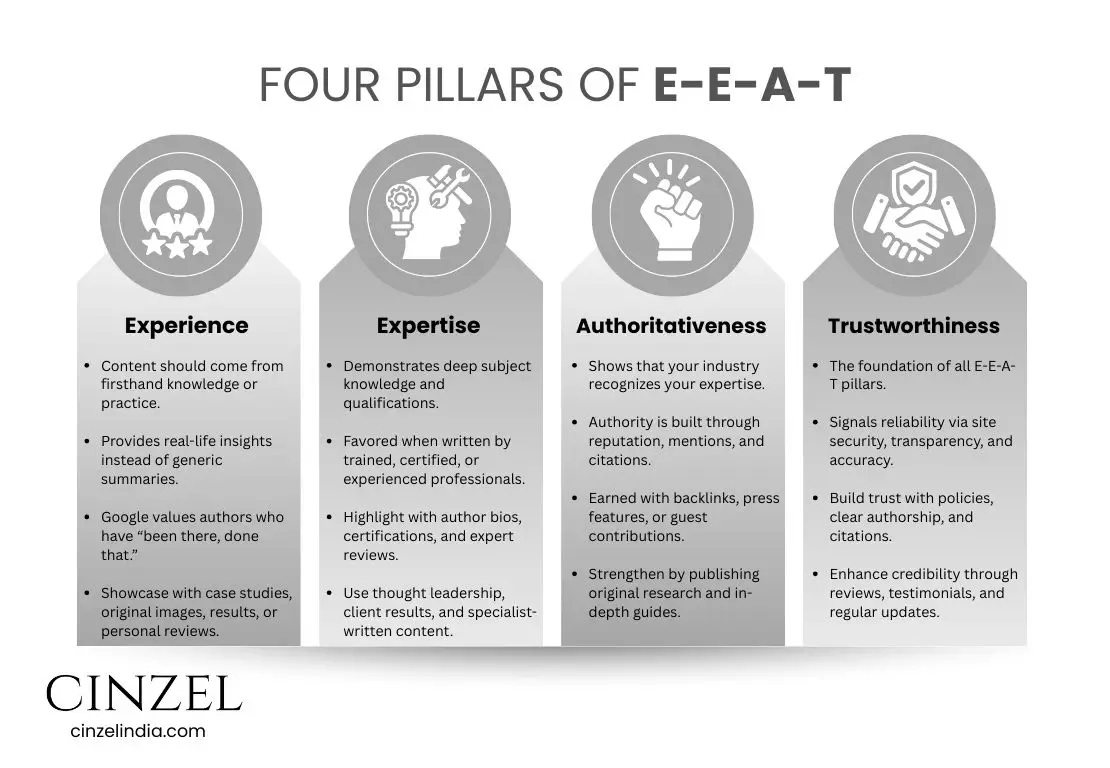
Experience
-
-
Content created from firsthand knowledge or practice.
-
Provides real-life insights, nuances, and practical tips.
-
Google prefers “been there, done that” over generic summaries.
-
Ways to showcase:
-
Case studies with detailed processes
-
Performance screenshots or results
-
Step-by-step experiments
-
Original images, before-and-after comparisons, or short videos
-
-
Expertise
-
-
Demonstrates deep knowledge and qualifications in a subject.
-
Favored when content is written by trained, certified, or experienced professionals.
-
How to highlight expertise:
-
Mention certifications (Google Analytics, HubSpot, SEMrush, etc.)
-
Showcase client results or success stories
-
Publish thought leadership or expert-reviewed content
-
-
Website best practices:
-
Add detailed author bios with credentials
-
Ensure important content is written/reviewed by specialists
-
-
Authoritativeness
-
- Proves that the industry recognizes your expertise.
- Authority comes from reputation, visibility, and recognition.
-
Signals of authority:
-
Mentions or backlinks from trusted websites
-
Being cited in articles, reports, or publications
-
Guest blogging, podcast appearances, or industry contributions
-
Social proof like press features or influencer mentions
-
-
Build by creating research-based, original, in-depth guides others want to cite.
Trustworthiness
-
-
The foundation of all E-E-A-T pillars.
-
Indicates if your content and website can be considered reliable and safe.
-
Key trust signals:
-
Secure website (HTTPS)
-
Transparent “About Us,” contact info, editorial guidelines, and policies
-
Accurate information with citations to reliable sources
-
Outbound links to official studies or guidelines0
-
-
Ways to increase trust:
-
Showcase customer reviews, testimonials, and case studies
-
-
-
-
Regularly update content with a “last updated” date
-
Fact-check every statistic and claim
-
Step-by-Step Action Plan to Improve E-E-A-T
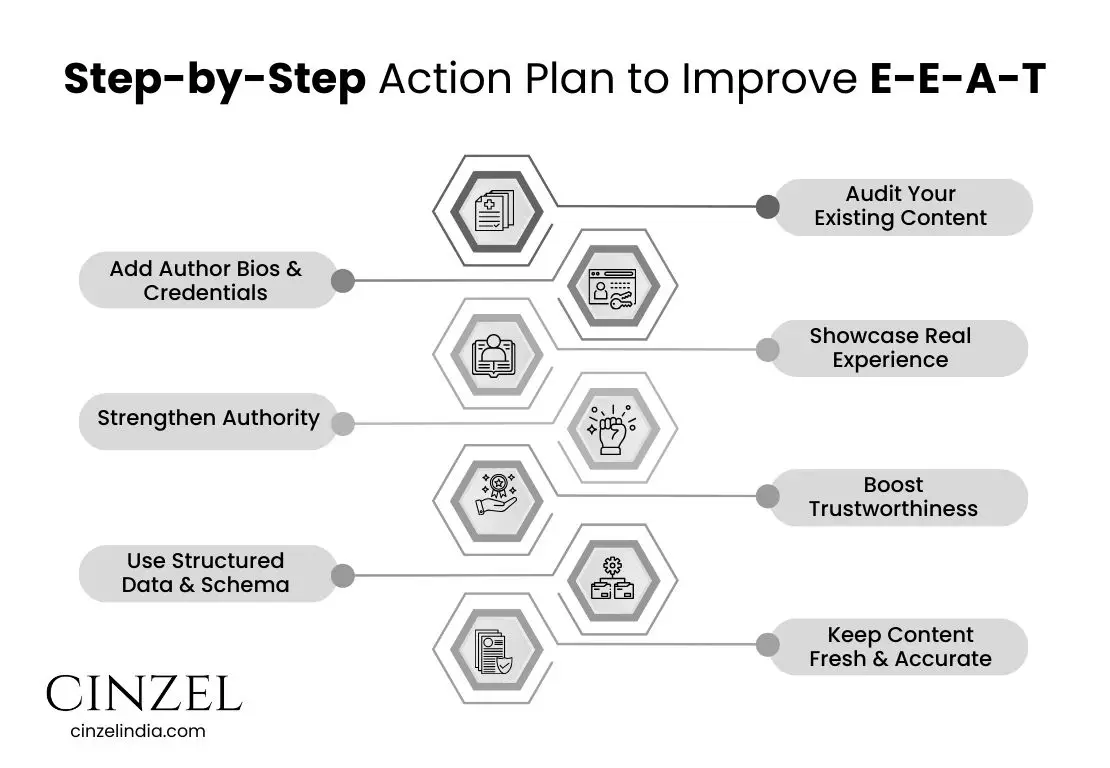
Audit Your Existing Content
-
-
Check if each article has an author name, bio, and supporting sources.
-
Flag thin, outdated, or generic posts that lack credibility.
-
Add Author Bios & Credentials
-
-
Include author details, qualifications, and LinkedIn links.
-
For YMYL content, ensure experts (doctors, lawyers, finance pros) review or write the content.
-
Showcase Real Experience
-
-
Add case studies, client results, personal product reviews, or original images.
-
Highlight “hands-on” insights instead of just theory.
-
Strengthen Authority
-
-
Build backlinks from trusted industry sites.
-
Publish guest posts, research studies, or data reports others can cite.
-
Add a “Featured In” or “Press Mentions” section.
-
Boost Trustworthiness
-
-
Use HTTPS, display contact details, policies, and disclaimers.
-
Collect and showcase genuine reviews/testimonials.
-
Be transparent with sources and fact-checking.
-
Use Structured Data & Schema
-
-
Add schema for authors, articles, FAQs, and reviews.
-
Helps Google understand and showcase credibility in search results.
-
Keep Content Fresh & Accurate
-
-
Regularly update old posts with new research, stats, or regulations.
-
Add “last updated” dates to signal freshness.
-
How to Demonstrate E-E-A-T on Your Website
Strong E-E-A-T signals are key to gaining both Google’s trust and your audience’s confidence.. Here are proven ways to showcase it:
Author Bios & Credentials
-
-
Include author bios that highlight qualifications, certifications, and expertise.
-
Link to the author’s LinkedIn profile or other reputable sources to validate expertise.
-
Especially important for YMYL content where credentials make the difference (doctors, lawyers, financial advisors, etc.).
-
Example: A health article signed off by Dr. Jane Smith, MD, Cardiologist (10+ years of experience).
-
Case Studies & Testimonials
-
-
Share real-life case studies or success stories that prove your first-hand experience.
-
Publish customer testimonials or reviews to build trustworthiness and authenticity.
-
Include photos, data, or results to make claims credible.
-
Example: A digital agency showcasing a case study on how they increased a client’s organic traffic by 200%.
-
External References & Citations
-
-
Back up claims with credible sources, research papers, government websites, or industry leaders.
-
Link out to trusted external sites (not competitors) to show transparency.
-
This strengthens authority and signals fact-checked accuracy.
-
Example: A financial blog citing data from World Bank or Forbes.
-
Structured Data & Schema Markup
-
-
Use schema markup to help Google understand your content better (e.g., Article, Author, Review, MedicalWebPage).
-
Structured data improves search visibility with rich snippets like star ratings, FAQs, and author details.
-
It also reinforces credibility by presenting key details directly in search results.
-
Example: A recipe blog using Recipe Schema to display cooking time, ratings, and calories in SERPs.
-
Content Updates & Freshness
-
-
Keep content regularly updated to maintain relevance and accuracy.
-
Add new research, statistics, or changes in industry standards.
-
Outdated content signals low trust, especially in fast-changing topics like health, finance, or tech.
-
Example: A cybersecurity blog updating articles after every major Google or Windows security patch.
-
Why YMYL Content Demands Strong E-E-A-T Signals
What is YMYL (Your Money or Your Life)?
YMYL means Your Money or Your Life — content that affects people’s health, safety, financial stability, or overall quality of life.
Google holds YMYL content to much higher standards because inaccurate or misleading information here can cause serious harm.
Examples of YMYL topics include:
-
-
-
Medical advice (symptoms, treatments, drugs)
-
Financial decisions (investments, taxes, loans, retirement planning)
-
Legal matters (contracts, immigration, criminal law)
-
Safety information (emergency responses, child care, cybersecurity)
-
-
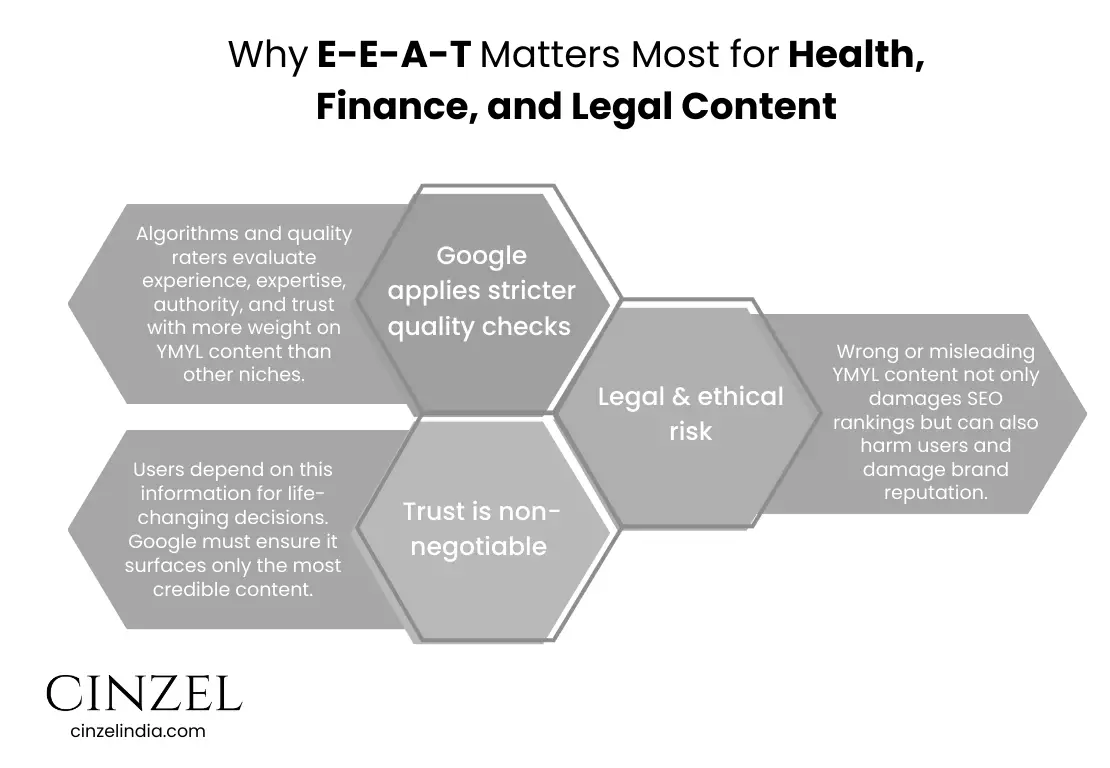
Why E-E-A-T Matters Most for Health, Finance, and Legal Content
-
-
-
Trust is non-negotiable – Users depend on this information for life-changing decisions. Google’s priority is to display only the most credible content.
-
Google applies stricter quality checks – Algorithms and quality raters evaluate experience, expertise, authority, and trust with more weight on YMYL content than other niches.
-
Legal & ethical risk – Wrong or misleading YMYL content not only damages SEO rankings but can also harm users and damage brand reputation.
-
-
In short: Without strong E-E-A-T signals, YMYL content is unlikely to rank well — no matter how well optimized for keywords.
Examples of YMYL + E-E-A-T in Action
-
-
-
Health (High E-E-A-T): Mayo Clinic — content reviewed by certified doctors, sources cited, updated frequently.
-
Finance (High E-E-A-T): Investopedia — authored by financial experts, citing trusted organizations (SEC, IRS, IMF)
-
Legal (High E-E-A-T): Nolo.com — legal guides by attorneys with disclaimers and easy-to-understand explanations.
-
-
Practical Tips to Improve E-E-A-T for SEO
Demonstrating Experience, Expertise, Authoritativeness, and Trustworthiness isn’t just about content—it’s about building credibility across your entire site. Here are actionable ways to strengthen your E-E-A-T:
Add Detailed About/Team Pages
-
-
Showcase who is behind the content.
-
Include author bios, team profiles, professional background, and qualifications.
-
Add photos, credentials, and links to LinkedIn or publications to boost transparency.
-
Example: A law firm’s website introducing each attorney, their bar membership, and years of experience.
-
Show Social Proof (Press Features, Awards, Certifications)
-
-
Highlight press mentions, industry awards, media coverage, or certifications your brand or team has received.
-
Create a “Featured In” or “As Seen On” section with logos of trusted publications.
-
This enhances authority and reputation signals.
-
Example: A startup displaying its recognition in Forbes and certifications like ISO or Google Partner badges.
-
Publish Original Research or Data Studies
-
-
Create unique content that others can reference, such as surveys, experiments, whitepapers, or industry reports.
-
Original research helps establish thought leadership and earns backlinks, reinforcing authority.
-
Even small-scale case studies or customer data analyses can add value.
-
Example: A marketing agency publishing an annual report on SEO trends backed by its client data.
-
Encourage Genuine User Reviews
-
-
Collect authentic testimonials on platforms like Google Reviews, Trustpilot, or industry-specific sites.
-
Showcase selected reviews directly on your website with star ratings or video testimonials.
-
Respond to both positive and negative reviews to build trust and transparency.
-
Example: A clinic featuring verified patient reviews and Google ratings on its homepage.
-
Future of E-E-A-T in the Age of AI & SGE
As Google evolves toward AI-powered search and the Search Generative Experience (SGE), the role of E-E-A-T is becoming even more important.
How Search Generative Experience (SGE) Relies on Trust Signal
-
-
SGE uses AI-generated summaries to answer user queries directly in search.
-
To avoid misinformation, Google must rely on high-trust content sources when generating these responses.
-
Websites with clear experience, verified expertise, strong authority, and proven trustworthiness will be more likely to be cited or featured in SGE results.
-
In practice: SGE will favor content that looks credible, fact-checked, and user-focused.
-
Predictions: Stronger Role of Expertise & Trust in AI-driven Results
-
-
Verified expertise will matter more: Content from real experts (with credentials visible) will have an edge.
-
Trust will outweigh keyword tricks: In an AI-driven search, accuracy, reputation, and transparency will count more than traditional on-page SEO tactics.
-
Brand authority will become critical: Recognized brands and authoritative voices will dominate SGE snippets.
-
Freshness will be key: AI will prefer up-to-date information, so regular content updates will play a bigger role.
-
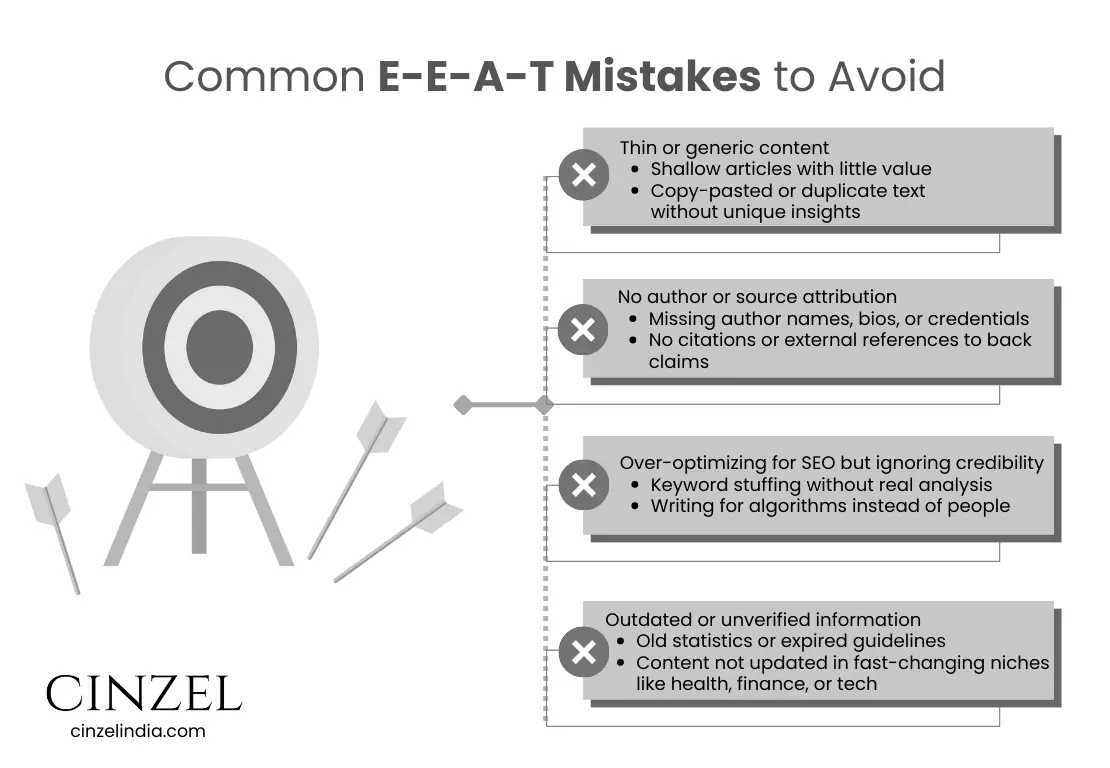
Common E-E-A-T Mistakes to Avoid
-
Thin or generic content
-
Shallow articles with little value
-
Copy-pasted or duplicate text without unique insights
-
No author or source attribution
-
Missing author names, bios, or credentials
-
No citations or external references to back claims
-
Over-optimizing for SEO but ignoring credibility
-
Keyword stuffing without real analysis
-
Writing for algorithms instead of people
-
Outdated or unverified information
-
Old statistics or expired guidelines
-
Content not updated in fast-changing niches like health, finance, or tech
E-E-A-T SEO Checklist
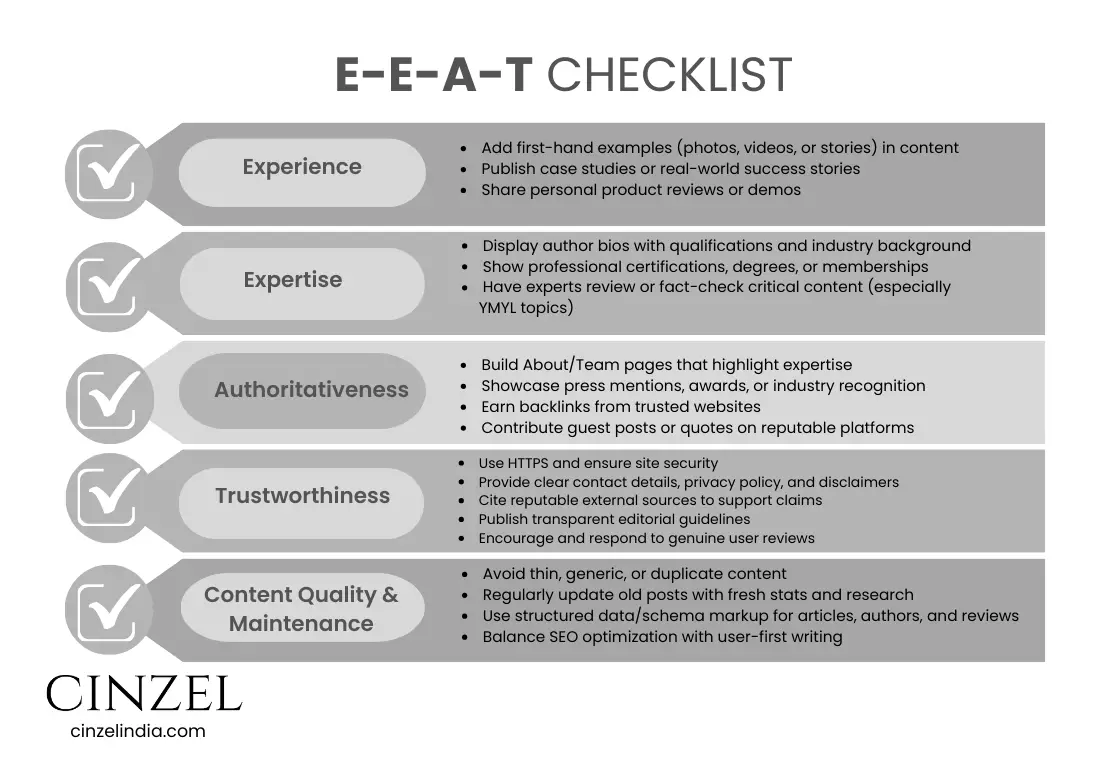
-
Experience -
Add first-hand examples (photos, videos, or stories) in content
-
Publish case studies or real-world success stories
-
Share personal product reviews or demos
-
Expertise
-
Display author bios with qualifications and industry background
-
Show professional certifications, degrees, or memberships
-
Have experts review or fact-check critical content (especially YMYL topics)
-
Authoritativeness
-
Build About/Team pages that highlight expertise
-
Showcase press mentions, awards, or industry recognition
-
Earn backlinks from trusted websites
-
Contribute guest posts or quotes on reputable platforms
-
Trustworthiness
-
Use HTTPS and ensure site security
-
Provide clear contact details, privacy policy, and disclaimers
-
Cite reputable external sources to support claims
-
Publish transparent editorial guidelines
-
Encourage and respond to genuine user reviews
-
Content Quality & Maintenance
-
Avoid thin, generic, or duplicate content
-
Regularly update old posts with fresh stats and research
-
Use structured data/schema markup for articles, authors, and reviews
-
Balance SEO optimization with user-first writing
E-E-A-T: Your Path to Long-Term Rankings
E-E-A-T is more than just a set of guidelines—it’s the foundation of long-term SEO success. Whether you’re running a health blog, financial website, legal firm, or even an eCommerce store, demonstrating real experience, proven expertise, industry authority, and user trust is the key to sustainable rankings. As Google continues to evolve with AI and the Search Generative Experience (SGE), websites that prioritize credibility, transparency, and accuracy will always have the edge. Start applying these E-E-A-T strategies today, and you’ll not only improve your search visibility but also earn the trust and loyalty of your audience.
